


If your doctor has recommended an endoscopy – or if you’ve been told you need an endoscopic ultrasound, an ERCP, or a procedure that goes beyond a standard scope — finding the right endoscopy specialist in Delhi matters more than finding the nearest one. The difference between a routine endoscopist and an interventional endoscopy specialist is the difference between a camera that looks and a tool that acts. One finds the problem. The other finds it and solves it in the same sitting.
Dr. Kapil Sharma is a gastroenterologist, hepatologist, and endosonologist practising in South Delhi – at GASTROQURE Liver, GI & Endoscopy Clinic in Kalkaji and as Head of Gastroenterology at Batra Hospital and Medical Research Centre. With over 15 years of clinical experience and fellowship-level training in endoscopic ultrasound (EUS), third-space endoscopy, and endoscopic submucosal dissection (ESD) – completed in China – he is among a small group of gastroenterologists in India who perform the full range of diagnostic, therapeutic, and interventional endoscopic procedures. Patients from Nehru Place, Greater Kailash, Lajpat Nagar, New Friends Colony, Saket, Hauz Khas, Malviya Nagar, and across Delhi NCR consult him for advanced endoscopy.
What Types of Endoscopy Does Dr. Kapil Sharma Perform?
Most patients think of endoscopy as one procedure – a camera down the throat or up through the rectum. In practice, endoscopy is a family of procedures, each using a different type of scope and targeting a different part of the body. Dr. Kapil performs the full range:
Upper GI Endoscopy (Gastroscopy) – a flexible endoscope inserted through the mouth to examine the oesophagus, stomach, and duodenum. Used to investigate persistent acidity, ulcers, swallowing difficulty, unexplained vomiting, and upper GI bleeding. Biopsies can be taken and bleeding can be treated during the same session.
Colonoscopy – a scope inserted through the anus to examine the entire large intestine and terminal ileum. Used for screening colorectal cancer, investigating blood in stool, chronic diarrhoea, and lower abdominal pain. Polyps can be removed during the procedure.
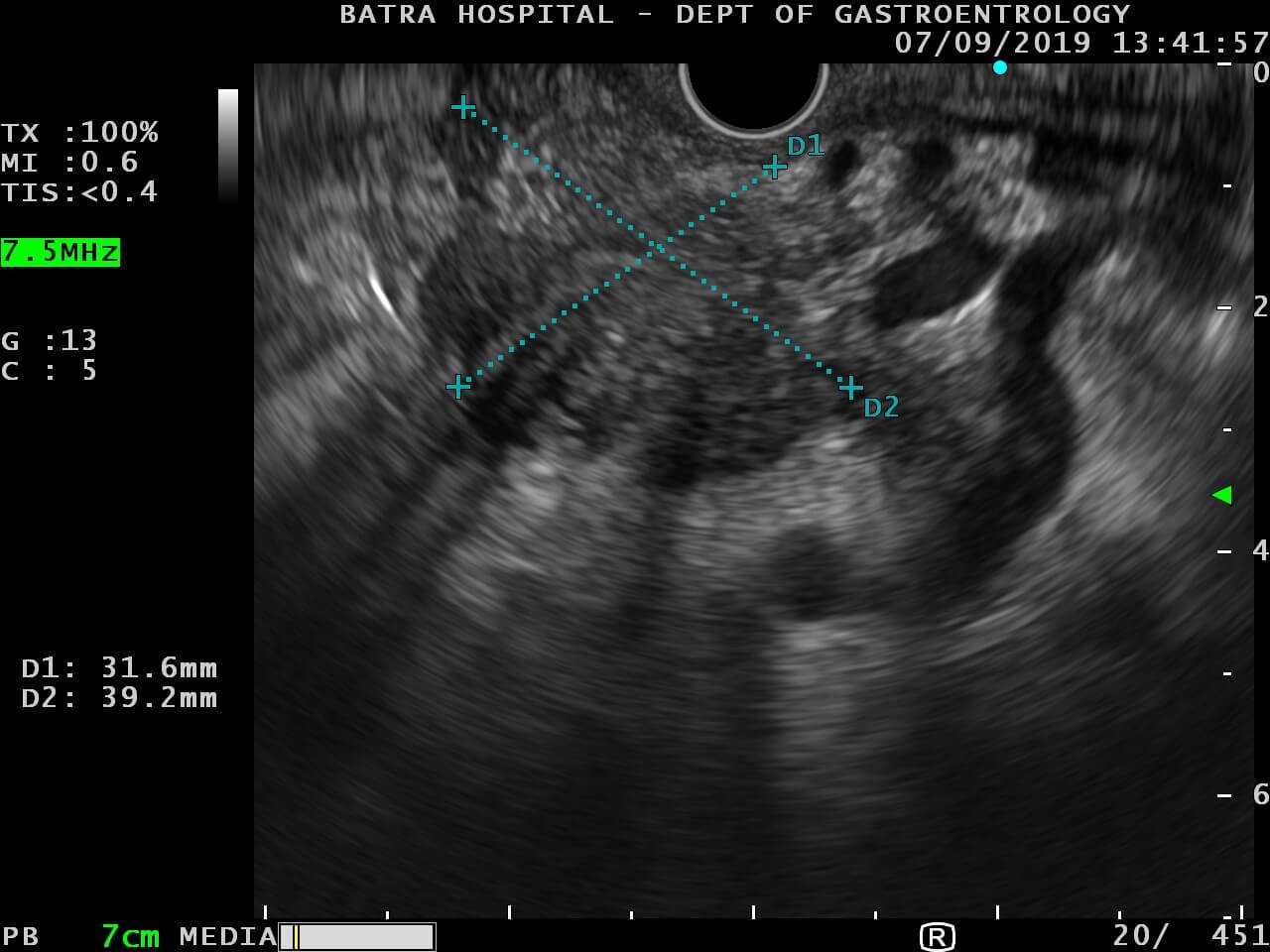
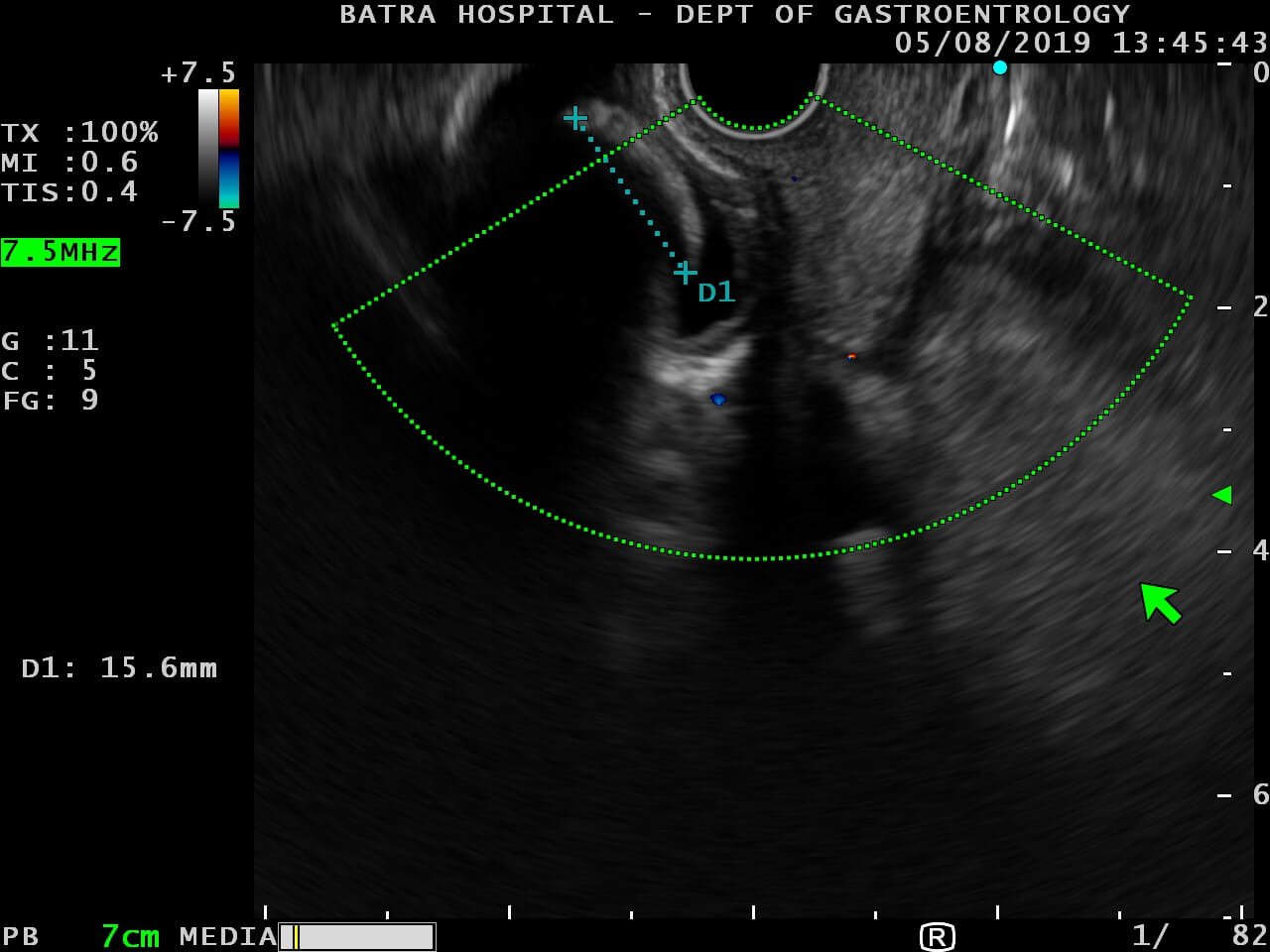
Endoscopic Ultrasound (EUS) – the most advanced diagnostic endoscopy available. An echoendoscope combines a camera with a high-frequency ultrasound probe at its tip, allowing the doctor to see not just the inner lining of the GI tract but the layers of the wall and the organs behind it — the pancreas, bile duct, gall bladder, liver, adrenal glands, and lymph nodes. This is where Dr. Kapil’s expertise is most differentiated.
ERCP (Endoscopic Retrograde Cholangiopancreatography) – a specialised endoscopic procedure to diagnose and treat problems in the bile duct and pancreatic duct. Used for removing bile duct stones, placing stents in blocked ducts, and taking biopsies from the biliary system.
Interventional EUS — this goes beyond diagnostic imaging. Using the EUS scope, Dr. Kapil can perform fine-needle aspiration (FNA) and fine-needle biopsy (FNB) of pancreatic masses, drain peripancreatic and perirectal collections directly into the stomach or rectum (avoiding open surgery), perform celiac plexus block for chronic pancreatitis pain, celiac plexus neurolysis for pancreatic cancer pain, EUS-guided biliary drainage when ERCP fails, and EUS-guided angiotherapy for gastric varices.
Third-Space Endoscopy — a subspecialty that includes POEM (Per Oral Endoscopic Myotomy) for achalasia cardia and submucosal tumour removal. This requires dedicated training beyond standard DM gastroenterology.
ESD (Endoscopic Submucosal Dissection) — en-bloc removal of early-stage cancers and large polyps from the GI tract without surgery, preserving the organ.
The range of procedures matters because a patient often arrives needing one type of endoscopy and ends up needing another — or needing a therapeutic intervention during what was planned as a diagnostic procedure. An endoscopy specialist who can handle everything from a routine gastroscopy to an EUS-guided pancreatic cyst drainage in the same practice means fewer referrals, fewer delays, and fewer separate procedures.
Endoscopic Ultrasound (EUS) – What It Is and Why It Matters
EUS deserves its own section because it’s the procedure that most clearly separates an advanced endoscopy specialist from a general endoscopist. Not every gastroenterologist in Delhi offers EUS — it requires a dedicated echoendoscope (significantly more expensive than a standard endoscope), specialised training, and a high case volume to maintain skill.
Here’s how EUS works: the echoendoscope is passed through the mouth (or, in some cases, through the rectum for lower GI assessment) under conscious sedation. Unlike a regular endoscopy, which only shows the surface lining, the ultrasound probe at the tip sends high-frequency sound waves through the gut wall. These waves bounce back from the layers of the wall and from adjacent organs — the pancreas, bile duct, gall bladder, liver, mediastinal lymph nodes, adrenal glands — creating detailed cross-sectional images on a monitor. The resolution is far superior to CT scan or MRI for structures that sit close to the GI tract, particularly the pancreas.
EUS can detect pancreatic tumours as small as 2 to 3 millimetres — lesions that a CT scan might miss entirely. It can see the layers of the oesophageal, gastric, or rectal wall, which is essential for staging cancers (determining how deep a tumour has invaded). And, crucially, it allows tissue sampling — the doctor can insert a fine needle through the echoendoscope, pass it through the gut wall under real-time ultrasound guidance, and take a biopsy from a pancreatic mass, a lymph node, or an adrenal lesion. This is EUS-guided FNA (fine needle aspiration) or FNB (fine needle biopsy), and it often provides a tissue diagnosis that avoids the need for exploratory surgery.
When Do You Need an Endoscopic Ultrasound?
Your doctor may refer you for EUS in the following situations:
A pancreatic mass or cyst found on CT or MRI that needs tissue confirmation before treatment can be planned. Staging of oesophageal, gastric, rectal, or pancreatic cancer — EUS determines how deep the tumour has invaded the wall and whether nearby lymph nodes are involved. A dilated common bile duct (CBD) on ultrasound or CT with no obvious cause — EUS can detect tiny stones, sludge, or early tumours that other imaging misses. Sampling of mediastinal or abdominal lymph nodes — for example, in suspected lung cancer, sarcoidosis, or lymphoma, where a tissue diagnosis is needed without surgery. Drainage of peripancreatic collections or pseudocysts — fluid collections that develop after acute pancreatitis can often be drained internally through the stomach wall using EUS guidance, avoiding open surgery. Celiac plexus block for pain management in chronic pancreatitis — a nerve block delivered through the stomach wall under EUS guidance that provides long-lasting pain relief. Celiac plexus neurolysis for pancreatic cancer pain — a similar approach using alcohol injection to destroy the nerve fibres, offering palliative pain relief. EUS-guided biliary drainage — when ERCP fails (which happens in about 5 to 10 percent of cases), EUS provides an alternative route for draining an obstructed bile duct.
In short, EUS is the investigation your gastroenterologist turns to when CT scans, MRI, and standard endoscopy haven’t provided a definitive answer — or when tissue is needed from a location that’s hard to reach any other way.
Why Dr. Kapil Sharma as Your Endoscopy Specialist in Delhi?
Dr. Kapil Sharma completed his MBBS from Government Medical College, Aurangabad, MD (General Medicine) from S.P. Medical College, Bikaner, and DM (Gastroenterology) from King George’s Medical University, Lucknow. He then pursued advanced training in third-space endoscopy and ESD in China, placing him among a small cohort of Indian gastroenterologists with this subspecialty expertise.
His track record in endoscopic ultrasound is particularly relevant. He was the first gastroenterologist from North India to publish a study on EUS-guided coiling for gastric varices — a complex interventional procedure. He has also published on modified POEM for achalasia cardia and, most recently, the world’s first Open Z POEM in the Video GIE journal. His publications in the Journal of Digestive Endoscopy, Liver International, and the Saudi Journal of Gastroenterology, along with the Asia Pacific Digestive Week travel grant and the Young Clinician Award in Shanghai, reflect a practice built on both clinical volume and academic output.
He heads the gastroenterology department at Batra Hospital — one of South Delhi’s established private hospitals, accessible via the Violet Line metro at Sarita Vihar station — and runs GASTROQURE Clinic in Kalkaji, within a 10 to 15 minute drive from Nehru Place, Greater Kailash, Lajpat Nagar, New Friends Colony, Okhla, and Saket.
What this means for a patient: your endoscopy — whether it’s a routine gastroscopy, a screening colonoscopy, or a complex interventional EUS — is being done by one of the best endoscopy specialists in Delhi, not by a junior doctor or a general surgeon. If something unexpected is found during a diagnostic scope, Dr. Kapil has the training to act on it in the same session.
Diagnostic EUS vs Interventional EUS – What’s the Difference?
Diagnostic EUS is the imaging component — the doctor uses the echoendoscope to visualise organs, assess tumour depth, check lymph nodes, and look for stones or masses. The output is high-resolution images and a detailed report. No tissue is taken, no treatment is performed.
Interventional EUS is where the echoendoscope becomes a treatment tool. The doctor passes instruments through the scope to perform procedures under real-time ultrasound guidance:
FNA/FNB — taking tissue samples from pancreatic masses, lymph nodes, or submucosal lesions for pathology. Pseudocyst and walled-off necrosis drainage — placing a stent through the stomach wall to drain infected or symptomatic pancreatic fluid collections. Celiac plexus block and neurolysis — delivering pain-relieving injections to the nerve bundle behind the stomach for chronic pancreatitis or pancreatic cancer. EUS-guided biliary drainage — creating an alternative bile drainage pathway when ERCP has failed, using a transmural stent. EUS-guided angiotherapy — treating gastric varices (dilated veins in the stomach) by injecting coils or glue under ultrasound guidance to stop or prevent bleeding.
Interventional EUS is a subspecialty skill. Most gastroenterologists in Delhi perform diagnostic EUS; far fewer offer the interventional range. Dr. Kapil offers both.
How to Prepare for an Endoscopy
The preparation depends on the type of endoscopy.
For upper GI endoscopy and EUS (oral route): Nothing by mouth for at least 6 to 8 hours before the procedure. This means no food, no water, no chewing gum. If you take regular medications, ask Dr. Kapil’s team which ones to continue and which to hold — blood thinners, diabetes medications, and anti-inflammatory drugs may need adjustment.
For colonoscopy and lower GI EUS: Bowel preparation is required — a clear liquid diet the day before and a bowel-cleansing solution in the evening. The goal is a completely clean colon for clear visualisation.
For all procedures: Inform the team about any allergies, medications, bleeding disorders, or previous reactions to anaesthesia. Bring someone with you — you won’t be able to drive yourself home after sedation. Wear comfortable, loose clothing. Blood tests and an anaesthesia fitness check may be needed beforehand, especially for interventional EUS or ERCP.
What Happens During the Procedure?
You’ll be given sedation through an IV line — either conscious sedation (drowsy but breathing on your own) or, for longer interventional procedures, monitored anaesthesia care managed by an anaesthetist. Either way, the procedure is painless.
For upper GI endoscopy and EUS, the scope is passed through the mouth. For colonoscopy, through the anus. The procedure is displayed on a high-definition monitor in real time. If biopsies are needed, they’re taken during the procedure. If polyps are found, they’re removed. If a pancreatic cyst needs draining, a stent is placed through the stomach wall under ultrasound guidance.
Procedure times vary: a standard upper GI endoscopy takes 10 to 15 minutes. A diagnostic EUS takes 20 to 40 minutes. An interventional EUS (drainage, FNA, celiac plexus block) can take 45 to 90 minutes depending on complexity.
After the Endoscopy – Recovery
You’ll rest in a recovery area until the sedation wears off — usually 30 to 60 minutes. It’s normal to feel slightly bloated or to have mild throat soreness (after upper GI procedures). These resolve within a few hours.
For diagnostic procedures, you can resume eating within 2 to 3 hours — start with light food and move to your normal diet by the next day. For therapeutic or interventional procedures, Dr. Kapil will give you specific instructions on diet, medications, and activity restrictions.
Most endoscopic procedures are day-care — you go home the same day. Interventional EUS procedures (particularly drainage procedures) may require an overnight stay for observation.
Risks – Being Transparent
Endoscopy is considered safe. Serious complications are rare — fewer than 1 in 1,000 for diagnostic procedures. For interventional EUS, complication rates are slightly higher (2 to 5 percent depending on the procedure) but are managed endoscopically in most cases.
Possible risks include bleeding (especially after biopsy, polypectomy, or FNA), perforation (a small tear in the GI wall, more common in therapeutic procedures), pancreatitis after ERCP (3 to 5 percent of cases), infection (rare, managed with prophylactic antibiotics for certain procedures), and reaction to sedation.
Dr. Kapil discusses these risks during the pre-procedure consultation. The decision to proceed is always a judgment call — the risk of the procedure weighed against the clinical information or treatment it provides.
Endoscopy Cost in Delhi
The cost depends on the type and complexity of the procedure:
Upper GI endoscopy (diagnostic) typically costs Rs 2,000 to Rs 5,000 in Delhi. Colonoscopy (diagnostic) ranges from Rs 5,000 to Rs 15,000. Diagnostic EUS costs between Rs 10,000 and Rs 25,000. Interventional EUS (FNA, drainage, celiac plexus block) ranges from Rs 20,000 to Rs 60,000 depending on what’s done. ERCP typically costs Rs 15,000 to Rs 40,000.
At GASTROQURE Clinic, Dr. Kapil’s team provides a cost estimate upfront. Batra Hospital is empanelled with most major health insurers for cashless treatment.
Finding an Endoscopy Specialist Near Me in Delhi
If you’ve been searching for an endoscopy specialist near me or an EUS doctor in South Delhi, here’s how to reach Dr. Kapil Sharma:
GASTROQURE Liver, GI & Endoscopy Clinic — K-81 B, Kalkaji, New Delhi — 110019. Accessible within 10 to 15 minutes from Nehru Place, Greater Kailash, Lajpat Nagar, New Friends Colony, Okhla, Saket, Hauz Khas, Green Park, and Malviya Nagar. Nearest metro: Kalkaji Mandir (Violet Line).
Batra Hospital and Medical Research Centre — Tughlakabad Institutional Area, Mehrauli-Badarpur Road. Nearest metro: Sarita Vihar (Violet Line), 5-minute walk.
Patients from Noida reach the clinic in 20 to 30 minutes via DND or Kalindi Kunj. Patients from Faridabad in 25 to 35 minutes via Badarpur border. Patients from Ghaziabad and East Delhi via the Ashram flyover or Violet Line metro.
Frequently Asked Questions
Is endoscopy painful?
No. All endoscopic procedures at GASTROQURE Clinic and Batra Hospital are performed under sedation. You won’t feel pain during the procedure. Mild throat soreness or bloating afterwards is common and resolves within hours.
What is the difference between endoscopy and endoscopic ultrasound (EUS)?
A standard endoscopy uses a camera to look at the inner surface of the GI tract. EUS adds a high-frequency ultrasound probe to the tip of the endoscope, allowing the doctor to see through the wall and image organs behind it — the pancreas, bile duct, lymph nodes. EUS also enables tissue sampling (FNA/FNB) from these deeper structures.
How long does an EUS take?
A diagnostic EUS takes 20 to 40 minutes. Interventional EUS (FNA, drainage, celiac plexus block) can take 45 to 90 minutes depending on what’s being done.
Do I need EUS or can a CT scan give the same information?
Not always. EUS provides higher resolution images of the pancreas, bile duct, and GI wall layers than CT. It can detect lesions as small as 2 to 3 millimetres that CT may miss. More importantly, EUS allows tissue sampling in the same session — a CT scan can only image, not biopsy.
Can EUS replace surgery for draining pancreatic collections?
In many cases, yes. EUS-guided drainage of pseudocysts and walled-off necrosis allows fluid collections to be drained internally through the stomach wall, avoiding open surgery. This is one of the key advantages of interventional EUS performed by an experienced endoscopy specialist.
Is EUS safe?
Yes. Diagnostic EUS has a complication rate below 1 percent. Interventional procedures carry slightly higher risks (2 to 5 percent) but complications are usually manageable endoscopically. Dr. Kapil discusses specific risks for your procedure during the consultation.
How often should I get an endoscopy?
This depends on your condition. Screening colonoscopy is recommended every 10 years starting at age 45 (sooner with risk factors). Surveillance endoscopy for Barrett’s oesophagus, inflammatory bowel disease, or a history of polyps is scheduled at intervals determined by your specific findings.
What should I eat after endoscopy?
After a diagnostic upper GI endoscopy, you can eat light food within 2 to 3 hours — idli, toast, khichdi, banana. After colonoscopy with polyp removal, a soft diet for 1 to 2 days. After interventional procedures, Dr. Kapil’s team will provide specific dietary instructions.
Does insurance cover endoscopy and EUS?
Most health insurance policies cover endoscopy and EUS when medically indicated. Batra Hospital is empanelled with most major insurers for cashless treatment. Check with your insurance provider, and Dr. Kapil’s team can assist with pre-authorisation.
Can Dr. Kapil Sharma treat what he finds during the endoscopy?
In most cases, yes. That’s the advantage of consulting an interventional endoscopy specialist. Polyps found during colonoscopy are removed immediately. Bleeding found during upper GI endoscopy is treated in the same session. Pancreatic masses found on EUS are biopsied immediately. Collections found on EUS can be drained in the same sitting. Fewer procedures, fewer delays.
Book an Endoscopy Consultation in Delhi
If you’ve been advised an endoscopy, an EUS, or an ERCP — or if you need a second opinion on findings from another centre — a consultation with Dr. Kapil Sharma can help determine the right procedure and what to expect.
Phone: +91-96258-18164 | +91-89203-59371
Email: drkapilsharma83@gmail.com





Dr. Kapil Sharma
MBBS, MD, DM Gastroenterology
Director and Head Gastroenterology Batra Hospital and Medical research centre, New Delhi.
He had more than 15 years of experience in field of Gastroenterology and Hepatology.
As a committed doctor, he had undergone advance endoscopic training in endoscopic ultrasound and third space endoscopy. Now he is amongst few Gastroenterologist across the country who do interventional endoscopic ultrasound and per oral endoscopic myotomy.