

If swallowing food has become a daily struggle – where every meal takes longer than it should, where you drink water between every bite just to push food down, or where you’ve started avoiding eating out because of the discomfort – you’re likely dealing with more than routine acidity. These are signs of achalasia cardia, and they don’t improve with antacids or home remedies.
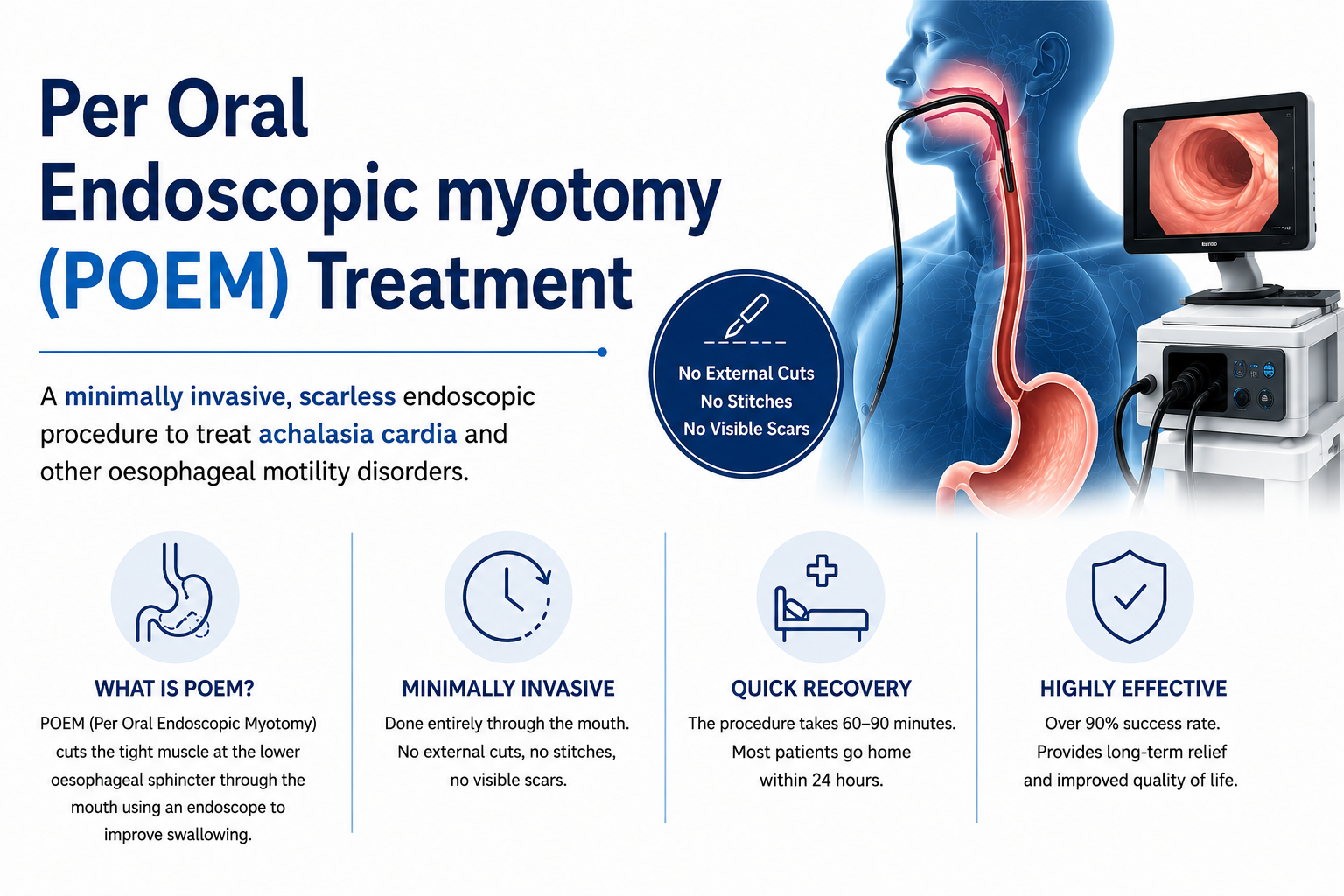
Dr. Kapil Sharma performs POEM (Per Oral Endoscopic Myotomy) in Faridabad and South Delhi for patients diagnosed with achalasia cardia and other oesophageal motility disorders. The procedure is done entirely through the mouth using a flexible endoscope – no cuts on the chest, no stitches, no visible scars. Most patients go home within 24 hours and return to eating normally within a week.
What Is Achalasia Cardia?
Achalasia cardia is a condition where the lower oesophageal sphincter – the muscular valve between your food pipe and stomach – stops relaxing the way it should. Normally, this valve opens when you swallow and closes once food enters the stomach. In achalasia, the valve stays tight. Food sits in the oesophagus instead of passing through. Over time, the food pipe stretches, and swallowing becomes harder.
The condition is uncommon. Roughly 1 in 100,000 people develop it each year. But for those who have it, the symptoms are hard to ignore:
Difficulty swallowing both solids and liquids. A feeling of food getting stuck behind the chest bone. Regurgitation of undigested food, sometimes hours after eating. Chest pain that can mimic heart problems. Unexplained weight loss because eating becomes so uncomfortable that people start skipping meals.
Many patients go months – sometimes years – before getting the right diagnosis. The symptoms overlap with acid reflux, and general practitioners often prescribe PPIs or antacids first. When those don’t work, that’s usually when a gastroenterologist gets involved and orders the right tests.
What Is the POEM Procedure?
POEM stands for Per Oral Endoscopic Myotomy. It was first performed in Japan in 2008 by Dr. Haruhiro Inoue and has since become the preferred treatment for achalasia cardia across the world.
Here’s what happens during the procedure: the gastroenterologist inserts a flexible endoscope through the mouth while the patient is under general anaesthesia. Using the endoscope’s camera and a small cutting tool, the doctor creates a tunnel in the inner lining of the oesophagus — between the mucosa (the innermost layer) and the muscle layer beneath it. This tunnel gives the doctor direct access to the circular muscle fibres of the lower oesophageal sphincter. Those tight muscle fibres are then carefully cut. Once the myotomy is complete, the tunnel entry is closed with small clips.
The entire procedure typically takes 60 to 90 minutes. There are no external incisions. The patient’s chest and abdomen remain untouched. Because everything happens through the natural opening of the mouth, recovery is significantly faster than traditional surgery.
Why POEM Over Other Treatment Options?
Before POEM became widely available, the standard treatment for achalasia was Heller’s myotomy — a laparoscopic surgery that cuts the same muscle but requires small incisions in the abdomen, along with a partial fundoplication (wrapping part of the stomach around the oesophagus to prevent reflux). Another option was pneumatic balloon dilation, which stretches the tight valve using a balloon. Both work, but each has limitations.
Heller’s myotomy requires general surgery, longer hospital stays (2 to 4 days), and recovery can take 2 to 4 weeks. Pneumatic dilation gives temporary relief in many cases but has a higher recurrence rate — studies show that up to 30 to 35 percent of patients need repeat dilations within five years.
POEM has changed the picture because it combines the precision of surgical myotomy with the recovery speed of an endoscopic procedure. Published data from multiple centres worldwide reports a clinical success rate above 90 percent at three-year follow-up. It works especially well for Type III achalasia, where the spastic contractions run along a longer segment of the oesophagus — a situation where Heller’s myotomy often falls short because the surgeon can’t extend the cut far enough.
Why Dr. Kapil Sharma for POEM in Faridabad?
Dr. Kapil Sharma is a gastroenterologist, hepatologist, and endosonologist with over 15 years of clinical experience. He completed his MBBS from Government Medical College, Aurangabad, followed by MD (General Medicine) from S.P. Medical College, Bikaner, and DM (Gastroenterology) from a recognised programme. He currently heads the Department of Gastroenterology at Batra Hospital and Medical Research Centre, New Delhi, and runs GASTROQURE — his private Liver, GI, and Endoscopy Clinic in Kalkaji, South Delhi.
His training in advanced endoscopy — specifically endoscopic ultrasound and third-space endoscopy — puts him in a small group of gastroenterologists in India who perform interventional EUS and POEM. Third-space endoscopy is a subspecialty that requires dedicated fellowship-level training beyond DM gastroenterology, and not every gastroenterologist offers it.
For patients in Faridabad, his clinic in Kalkaji is roughly a 30-minute drive via the Badarpur border route. He also consults at Batra Hospital, which is accessible via the Violet Line metro (Sarita Vihar station). Patients from Faridabad, Greater Faridabad, Ballabhgarh, Palwal, and surrounding Haryana areas regularly visit for POEM consultations.
Step-by-Step: What Happens During POEM
Before the Procedure
You’ll need a set of diagnostic tests before POEM can be scheduled. A high-resolution oesophageal manometry confirms the diagnosis and identifies the achalasia subtype (Type I, II, or III). An upper GI endoscopy checks the oesophagus and stomach for any other issues. A barium swallow study shows how food moves through the oesophagus. Blood tests and an anaesthesia fitness evaluation round out the workup.
During the Procedure
You’ll be under general anaesthesia — you won’t feel anything. The endoscope goes in through the mouth. A submucosal tunnel is created in the oesophageal wall, starting about 10 to 12 centimetres above the lower oesophageal sphincter. The doctor works down through this tunnel, cutting the inner circular muscle fibres of the sphincter. Once the myotomy is done, the mucosal entry point is sealed with endoscopic clips. The whole process usually wraps up in about 60 to 90 minutes.
After the Procedure
You’ll stay under observation for one night. The next morning, a quick contrast swallow study (you drink a special liquid while an X-ray is taken) confirms there are no leaks. If everything looks clean, you start on clear liquids the same day. Soft foods come in after 2 to 3 days. Most patients return to a normal diet within a week. You can typically go back to work within 3 to 5 days — desk jobs sooner, physically demanding work a bit later.
Who Is a Good Candidate for POEM?
POEM works best for patients with a confirmed diagnosis of achalasia cardia — any subtype. It’s also used for other oesophageal motility disorders like diffuse oesophageal spasm, jackhammer oesophagus, and in some cases, gastroparesis (using a modified version called G-POEM or gastric POEM).
You may be a candidate if your manometry report confirms achalasia or a spastic motility disorder, you’ve tried medications or balloon dilation without lasting relief, your swallowing difficulty is affecting your weight, nutrition, or quality of life, or you want a treatment with a shorter recovery than open or laparoscopic surgery.
Age is rarely a barrier. POEM has been performed safely on patients ranging from teenagers to people in their eighties. The decision comes down to your overall fitness for general anaesthesia and whether your specific condition matches what POEM can address.
Risks and Side Effects — What to Expect
No procedure is risk-free, and it would be dishonest to pretend otherwise. POEM is considered safe — complication rates in large published series sit below 5 percent — but here’s what can happen:
Subcutaneous emphysema (air trapped under the skin) is the most common issue. It sounds alarming but usually resolves on its own within 24 to 48 hours. Mucosal perforation during the tunnel creation can happen, though it’s rare in experienced hands and is usually managed endoscopically during the same session. Post-procedure reflux is the most discussed long-term concern. Because the sphincter muscle is cut and no anti-reflux wrap is added (unlike in Heller’s myotomy with fundoplication), some patients develop gastro-oesophageal reflux after POEM. Studies report reflux symptoms in about 20 to 30 percent of patients, though most respond well to standard acid-suppressing medications.
Dr. Kapil discusses these risks during the pre-procedure consultation so that you know what you’re agreeing to and what follow-up looks like.
Recovery Timeline After POEM
Day 1: Procedure day. You’ll be in hospital overnight. Clear liquids start the evening of the procedure or the next morning, depending on how things went.
Day 2: Contrast swallow study in the morning. If the results are normal, you’re discharged. Soft foods begin — think dal, khichdi, curd rice, mashed banana, soups.
Days 3 to 5: Gradual return to a soft diet. Avoid anything hard, crunchy, or very spicy for the first week.
Week 2 onward: Most patients are eating normally. Follow-up with Dr. Kapil is scheduled around the 2-week mark, and then again at 3 months for a repeat manometry to confirm the sphincter pressure has dropped.
POEM Treatment Cost in Faridabad
The cost of POEM varies depending on the hospital, anaesthesia charges, and the length of hospital stay. In the Delhi-NCR region, including Faridabad, the procedure typically falls in the range of Rs 1.5 lakh to Rs 3 lakh. The exact figure depends on whether you choose a private room, the type of insurance coverage you have, and whether additional tests are needed.
During your consultation, Dr. Kapil’s team provides a detailed cost estimate upfront. If you have health insurance, check whether your policy covers POEM — most cashless policies at empanelled hospitals do.
Frequently Asked Questions About POEM Treatment
Is the POEM procedure painful?
No. You’re under general anaesthesia throughout. After the procedure, mild chest discomfort or throat soreness is common for a day or two — manageable with standard painkillers. Most patients describe it as far less painful than they expected.
How long does the POEM procedure take?
Usually 60 to 90 minutes. In complex cases — such as patients who’ve had prior failed treatments or have a significantly dilated oesophagus — it may take a bit longer.
Can achalasia come back after POEM?
In a small percentage of patients, symptoms can recur. Published data shows that more than 90 percent of patients maintain good swallowing function at 3 to 5 years post-POEM. If symptoms do return, the procedure can sometimes be repeated, or alternative treatments can be considered.
Is POEM better than Heller’s myotomy?
For most patients, POEM gives comparable or better results with a shorter recovery. The advantage is clearest in Type III achalasia, where POEM allows the doctor to extend the myotomy along a longer stretch of the oesophagus — something that’s technically harder with laparoscopic surgery. The trade-off is a slightly higher rate of post-procedure reflux compared to Heller’s with fundoplication.
How soon can I eat normally after POEM?
Clear liquids start on day 1. Soft foods from day 2 to 3. Most patients eat a normal diet by the end of the first week. Spicy and very hard foods should wait until the 2-week mark.
Do I need to stay in the hospital?
One night. If the contrast swallow the next morning looks normal, you’re discharged the same day. Occasional cases may need a second night for observation.
Will I need medication after POEM?
A short course of acid-suppressing medication (a PPI like pantoprazole) is typically prescribed for 4 to 8 weeks after POEM to prevent reflux while the oesophagus heals. Some patients continue a low-dose PPI long-term if reflux symptoms develop.
Can POEM be done for conditions other than achalasia?
Yes. POEM is also used for diffuse oesophageal spasm, jackhammer oesophagus, and — in a modified form called G-POEM — for gastroparesis (delayed stomach emptying). The decision depends on your specific diagnosis and manometry findings.
Book a POEM Consultation in Faridabad
If you’ve been diagnosed with achalasia cardia or are dealing with persistent swallowing difficulty that hasn’t responded to medication, a consultation with Dr. Kapil Sharma can help determine whether POEM is the right option for you.
GASTROQURE Liver, GI & Endoscopy Clinic is located at K-81 B, Kalkaji, New Delhi — 110019. Patients from Faridabad (Sector 15, 16, 21, NIT, Old Faridabad, Greater Faridabad, Ballabhgarh) can reach the clinic in 25 to 35 minutes by road.
Phone: +91-96258-18164 | +91-89203-59371
Email: drkapilsharma83@gmail.com


Dr. Kapil Sharma
MBBS, MD, DM Gastroenterology
Director and Head Gastroenterology Batra Hospital and Medical research centre, New Delhi.
He had more than 15 years of experience in field of Gastroenterology and Hepatology.
As a committed doctor, he had undergone advance endoscopic training in endoscopic ultrasound and third space endoscopy. Now he is amongst few Gastroenterologist across the country who do interventional endoscopic ultrasound and per oral endoscopic myotomy.